Why AI Won’t Fix Your Enterprise Problems Without the Right IT Foundation

Machine Learning Explained: A Simple Guide for Business Leaders
February 15, 2026
Hybrid Cloud vs. Private Cloud: Choosing the Right Cloud Strategy for Your Business
May 11, 2026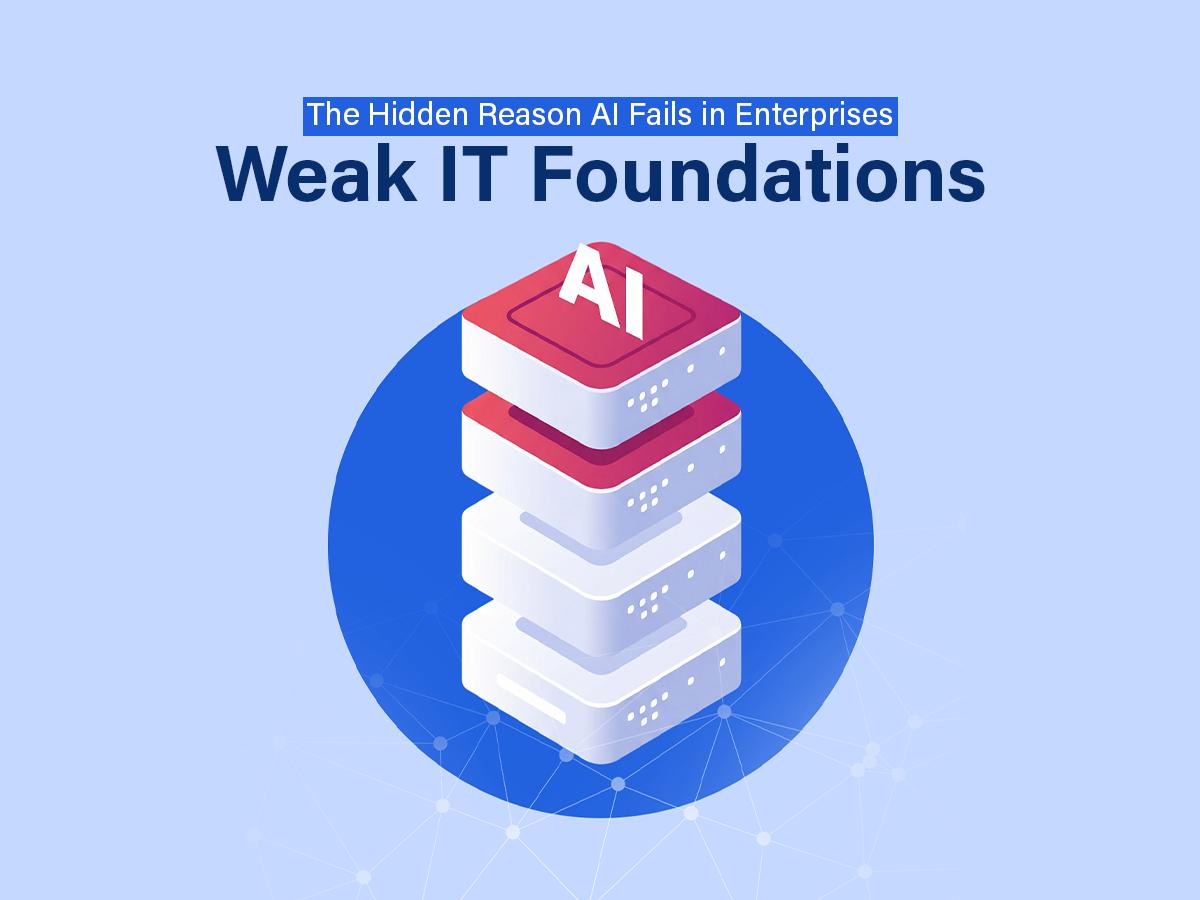
Artificial intelligence has become a strategic priority for enterprises across industries. From predictive analytics and intelligent automation to advanced decision support, AI promises efficiency, agility, and competitive differentiation. Yet many organizations invest heavily in AI initiatives and fail to realize meaningful returns. In most cases, the issue is not the AI technology itself but the lack of a solid IT foundation capable of supporting it.
AI is not a standalone solution. It is an advanced capability that relies entirely on the strength, readiness, and resilience of the underlying enterprise ICT environment.
AI Is Only as Strong as the Infrastructure Beneath It
AI workloads place substantial demands on enterprise infrastructure. High-performance compute resources, scalable storage, resilient architectures, and reliable availability are essential requirements. Without these foundations, AI systems struggle with latency, downtime, and inconsistent performance.
Enterprises that attempt to deploy AI on fragmented or legacy infrastructure often encounter operational bottlenecks that undermine model accuracy and real-time responsiveness. As a result, AI initiatives remain confined to pilots rather than becoming enterprise-wide capabilities.
A modern ICT infrastructure provides the performance, scalability, and resilience required to support AI at production scale.
Data Readiness Determines AI Effectiveness
AI systems are driven by data, yet data readiness remains one of the most underestimated challenges in AI adoption. Many enterprises operate with siloed data sources, inconsistent formats, and limited governance. These conditions severely restrict AI’s ability to generate reliable insights.
Without a well-architected data environment, AI models amplify existing inefficiencies rather than solving them. Clean, structured, and accessible data requires robust data platforms, integration layers, and governance frameworks—elements that must be embedded within the enterprise ICT foundation.
True AI value emerges only when data flows securely, consistently, and accurately across the organization.
Network Performance and Visibility Enable AI at Scale
AI-driven applications—particularly in enterprise and Fintech environments—depend heavily on network performance. Real-time analytics, automated transactions, and intelligent services require continuous, low-latency connectivity.
Limited network visibility delays fault detection and slows response times, increasing operational risk. When networks are treated solely as technical components rather than business-critical assets, AI systems fail to deliver consistent outcomes.
An observable, resilient network environment is essential for sustaining AI-driven operations and maintaining business continuity.
Security Must Be Embedded, Not Added Later
AI expands the enterprise attack surface. Increased data access, automated decision-making, and interconnected systems introduce new security and compliance challenges. Without a strong cybersecurity foundation, AI adoption exposes organizations to heightened operational and regulatory risk.
Security must be integrated across the ICT stack—covering infrastructure, networks, identities, applications, and data. Continuous monitoring, access control, encryption, and governance are non-negotiable elements in AI-enabled environments.
Enterprises that embed security into their ICT foundations enable AI innovation without compromising trust or compliance.
Build the ICT Foundation Before Scaling AI
Successful AI adoption follows a disciplined sequence. Enterprises that achieve sustainable outcomes invest first in strengthening their ICT foundations—modernizing infrastructure, improving network visibility, establishing data readiness, and aligning security frameworks.
This approach allows AI to transition from experimentation to enterprise-scale deployment. More importantly, it ensures that AI initiatives align with operational priorities, regulatory requirements, and long-term business strategies.
AI delivers impact only when supported by a mature, enterprise-grade ICT environment.
How ICT Misr Enables AI-Ready Enterprises
At ICT Misr, we recognize that AI success begins with ICT readiness. As an ICT-level solutions provider, we help enterprises build the foundational capabilities required to support advanced technologies such as AI, Fintech, and intelligent automation.
Our approach spans end-to-end ICT domains, including enterprise infrastructure, networking, cybersecurity, data platforms, and emerging digital technologies. Certified ICT Misr teams engage from initial assessment and consultation through architecture design, implementation, and continuous optimization.
By combining deep technical expertise with trusted global technology partnerships, ICT Misr enables organizations to establish secure, scalable, and high-performance ICT environments—designed not only to support AI adoption but also to sustain it over time.
AI alone will not resolve enterprise challenges. Without a strong IT foundation, AI initiatives remain constrained by performance limitations, data gaps, security risks, and operational instability.
Enterprises that succeed with AI are those that treat it as part of a broader ICT strategy—one built on resilient infrastructure, reliable networks, secure environments, and well-governed data platforms. These foundations enable AI to move beyond experimentation and deliver consistent, measurable business value.
As an ICT-level solutions provider, ICT Misr plays a critical role in enabling this readiness. Through comprehensive, end-to-end ICT solutions, ICT Misr helps enterprises establish the technical backbone required for AI, Fintech, and intelligent automation. By strengthening ICT foundations first, organizations can adopt AI with confidence—ensuring innovation is scalable, secure, and aligned with long-term operational and strategic objectives..